RITQ Shares Insights on Strengthening Teacher Education at 8th SMEC Research Congress
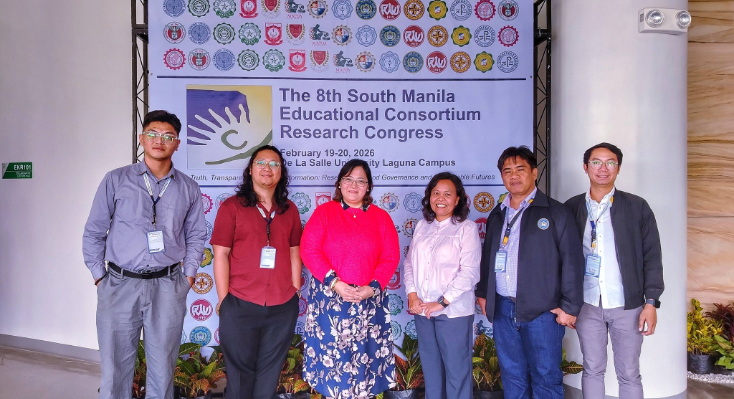
RITQ researchers Mikkey Mari Tuazon and Edrian Josh Mangila with PNU Professors at the 8th SMEC Research Congress 2026.
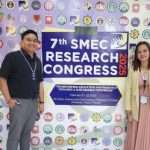
Laguna, Philippines – RITQ participated in the 8th South Manila Educational Consortium (SMEC) Research Congress held at the De La Salle University-Laguna Campus on February 19, 2025.
Representing RITQ were project officer Mikkey Mari Tuazon and research analyst Edrian Josh Mangila, who showcased two studies addressing key developments in pre-service teacher education in the Philippines. They joined the Philippine Normal University’s delegation, led by Dr. Teresita T. Rungduin, Vice President for Research, Extension, and Quality Assurance. Their presentations contributed to scholarly discussions aligned with this year’s theme, “Truth, Transparency, and Transformation: Research for Good Governance and Sustainable Futures.”
A key feature of this year’s congress is the introduction of a “huddle and conversation” format for paper presentations. This approach fostered more interactive, collaborative exchanges among participants, enabling presenters and attendees to engage in deeper, more meaningful discussions of research findings and their implications.

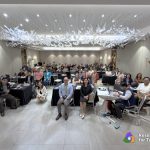
Mr. Tuazon at a parallel huddle and discussion session.
Mr. Tuazon presented a review of policy directions examining how recent educational reforms influence curriculum development in teacher education. Through qualitative analysis of key policy documents over the past decade, the study identified recurring directions that shape curriculum design, including outcomes-based education, learner-centered approaches, technological integration, and experiential learning. The findings emphasize the importance of aligning teacher education curricula with national policy directions to ensure coherence between national reforms, teacher preparation programs, and professional practice. The study further highlights the role of systematic policy review as a foundation for evidence-informed curriculum design and development.

Mr. Mangila at a parallel huddle and discussion session.
Meanwhile, Mr. Mangila presented a study on innovative curriculum implementation and support mechanisms among Teacher Education Institutions (TEIs). The research identified three major curriculum models: the Enriched Model, which enhances the prescribed curriculum program’s content and structures; the Integration Model, which embeds institutional advocacies in curricula through various approaches; and the Bachelor’s-Master’s Straight Program, which offers a research-intensive, integrated pathway for teacher preparation. The study also highlighted a range of support systems provided by TEIs, including academic, financial, and mental health services for pre-service teachers, as well as professional development and work-life balance initiatives for teacher educators. These findings underscore TEI’s commitment to developing resilient and responsive preservice teacher education programs.
With these contributions, RITQ reinforces its continuing commitment to serve as a thought leader in teacher and teaching quality through meaningful research that contributes to national development and sustainable futures. (RITQ Communications)
[Image courtesy of De La Salle University]
https://www.ritq.ph/?p=6093NewsSouth Manila Educational Consortium (SMEC),Teacher Education Institutions