Strengthening Teacher Quality through Collective Expertise: RITQ and Partners Conclude Phase 2 of the Reframed Pre-service Teacher Education Curriculum

A photo collage of the RITE 2 Writeshop Activities.
MANILA, Philippines — In an effort to strengthen teacher quality, the Research Institute for Teacher Quality (RITQ) of the Philippine Normal University (PNU), in partnership with the Teacher Education Council (TEC) and the Commission on Higher Education (CHED), has successfully concluded an intensive series of research activities ranging from development writeshops to stakeholders’ feedback. This marks the culmination of Phase 2 of the ongoing nationwide effort to reframe the pre-service teacher education curriculum.
While Phase 1 of this initiative laid the groundwork for Pre-service Teacher Professional Education, Phase 2 focused on the reframing of the specialization component and the development of various undergraduate certificate programs. By deliberating the critical directions and decision points for these specialized programs, RITQ and its partners ensured that future teachers are comprehensively prepared to meet the dynamic demands of the Philippine basic education system.
A Phased Approach to Curricular Innovation
The journey of Phase 2 began in July 2025 with an onboarding workshop in Binondo, Manila, to ensure a responsive and robust curriculum. This set the stage for a rigorous technical process divided into four major writeshops:
- Writeshop 1 (July 9–11): Focused on the specialization component of various teacher education degree programs, diving deep into the directions required to strengthen the quality of pre-service teacher preparation across the nation.
- Writeshop 2 (August 18–20 & 27–29): Collaborative teams developed curriculum frameworks, reframed degree/certificate program outcomes and performance indicators, and drafted specialization courses with detailed course descriptions.
- Writeshop 3 (October 22–24 & November 5–7): A refinement phase driven by stakeholders’ feedback gathered through Zonal Public Hearings, ensuring the curriculum is relevant and responsive to the current needs of the country.
- Writeshop 4 (November 26–28): The final stage of development writeshops, which focused on drafting syllabus guides to enhance the instructional quality of the new specializations.
Reframing Specializations and Certificate Programs
The project’s scope covered various discipline areas:
- Bachelor of Education Disciplines: Science, Mathematics, English, Filipino, Social Studies, Values Education, Arts and Culture Education, and Physical and Health Education.
- Early Grades and Vocational Tracks: Bachelor of Early Childhood Education, Bachelor of Elementary Education (with concentration areas), Bachelor of Special Needs Education, and Bachelor of Career Technical Education (BCTED).
- Designed Certificate Programs: New pathways were refined for the Certificate in Teaching Program, Literacy Education, Multigrade Education, Alternative Learning System (ALS), and Indigenous Peoples (IP) Education.
Strategic Insights and National Directions
The writeshops featured a convergence of curriculum specialists, teacher educators, and discipline experts. Dr. Jennie V. Jocson, Executive Director V of the Teacher Education Council (TEC) Secretariat, emphasized the project’s vision:
“Beyond revising the courses and program outcomes, we aspire that our work in reframing the curriculum also includes steering teacher education to where we want to bring it—noting that reforms must begin where quality resides, and quality resides in our teachers.”
To provide crucial context, resource persons shared insights on the Future Skills Framework, the integration of Peace Education, and weaving ALS principles into pedagogy and assessment. Technical consultants, including Dr. Joy Hardy of UNE-SiMERR and Dr. Edizon Fermin of the CHED Technical Panel for Teacher Education (TPTE), provided valuable inputs on refining program outcomes to meet international standards.
Validation through Zonal and National Public Hearings
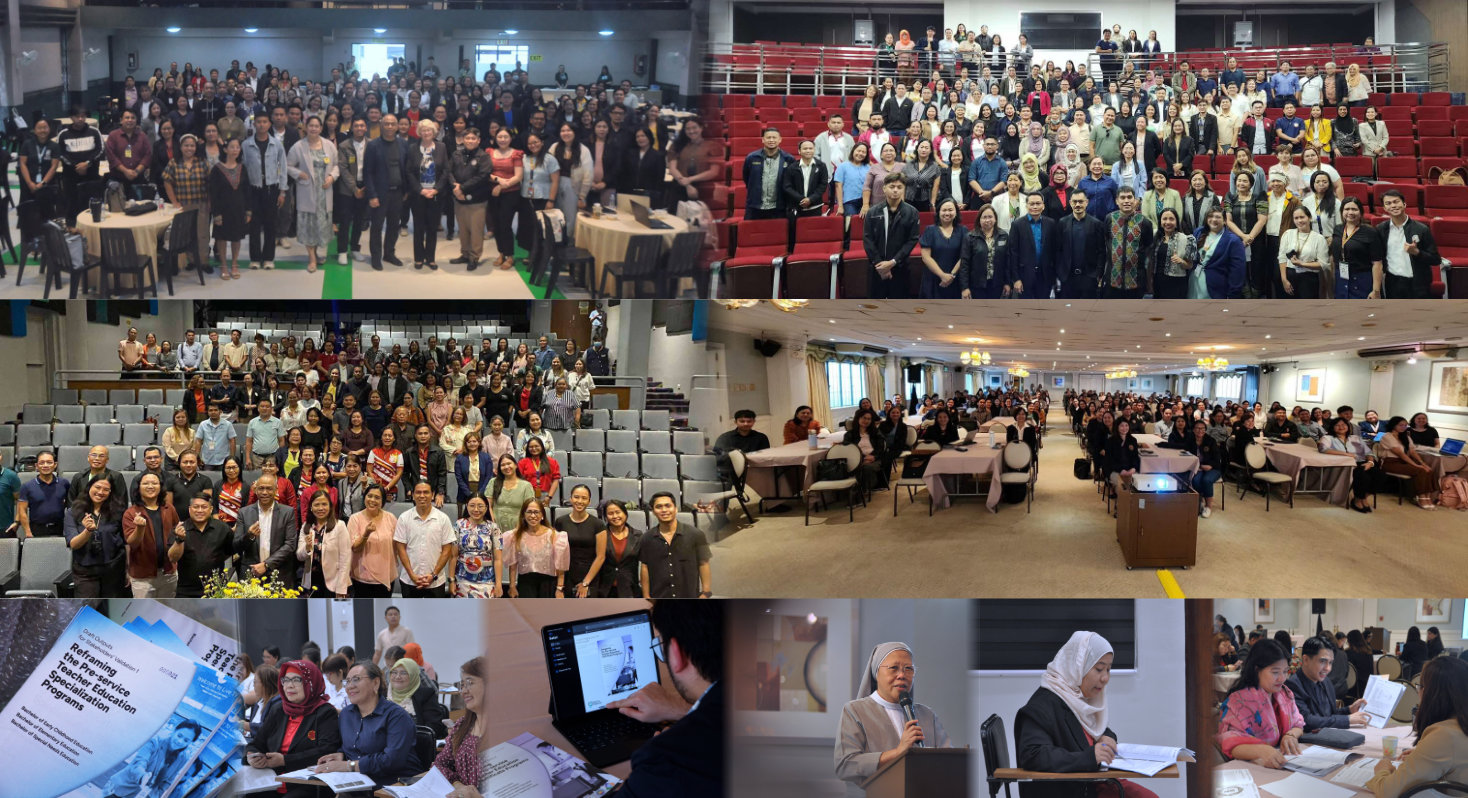
A photo collage of the Consultative and Collaboration Validation – Zonal Public Hearings in Luzon, Visayas, Mindanao, and NCR in October 2025.
One of the defining features of Phase 2 was its commitment to a consultative and context-driven process. To ensure the Models of Pre-service Teacher Education Curricula and Programs were grounded in local realities, RITQ conducted a series of Zonal Public Hearings across the country in October 2025:
- Mindanao (October 6): hosted by Mindanao State University-General Santos in General Santos City, South Cotabato;
- Visayas (October 7): hosted by the University of San Carlos in Cebu City, Cebu;
- NCR (October 8): hosted by St. Paul University-Manila in Malate, Manila; and
- Luzon (October 10): hosted by the University of the Cordilleras in Baguio City, Benguet.
These consultations allowed discipline practitioners and teacher educators to provide expert feedback on the initial proposals and outputs. This culminated in an Online National Public Consultation on November 12, 2025, where participants representing various Teacher Education Institutions (TEIs) validated the refined outputs. Dr. Edizon Fermin noted:
“The stakes could not be higher, but neither could the promise be greater. We are not merely adjusting curriculum; we are redefining what it means to be a teacher. A better one, in, of, and for our beloved Philippines. We are crafting the blueprint for educators who will shape our nation’s future, where we act as architects of transformation with the sacred responsibility of shaping minds and hearts.”
Stakeholders reviewed the curriculum’s adaptability, its power to address gaps in teacher competencies, and its alignment with improving K–12 learning outcomes.
Implications and Future Directions
As Phase 2 concludes, the collaborative efforts of the Curriculum Development Teams have shaped a curriculum that is both relevant and responsive. The successful drafting of syllabus guides and specialization frameworks represents a significant step toward a more specialized teaching force.
Looking ahead, RITQ and its partners are preparing for the next vital phase: supporting the national transitory implementation of the reframed curriculum. This upcoming stage will be critical in ensuring that the developed curriculum models are effectively integrated into TEIs nationwide, ultimately transforming the landscape of Philippine education. (RITQ Communications)
https://www.ritq.ph/?p=6058https://www.ritq.ph/wp-content/uploads/2026/03/030326-RITE-2-WRITESHOPS-1024x557.jpghttps://www.ritq.ph/wp-content/uploads/2026/03/030326-RITE-2-WRITESHOPS-150x150.jpgFeatureNewsPre-Service Teacher Education,Reframing the Pre-service Teacher Education Curriculum,RITE,Teacher Education Council