Dr. Pegg shares insights to strengthen capabilities of TEC personnel

Dr. Pegg discusses the relationship between teachers and systems.
Dr. John Pegg, director of the UNE-SiMERR National Research Centre and co-director of RITQ, spoke at a professional sharing session organized by the Teacher Education Council (TEC) secretariat for its personnel on 15 October 2024.
Held at the Department of Education (DepEd) central office, the session aimed to enhance the capacity of TEC personnel regarding their institutional roles, the Philippine Professional Standards for Teachers (PPST), and future directions for teacher education in the Philippines.
The event gathered representatives from the Department of Education’s Bureau of Human Resources and Organizational Development (BHROD), the National Educators’ Academy of the Philippines (NEAP), and the Second Congressional Commission on Education (EDCOM 2). RITQ Director Dr. Brando Palomar, Senior Program Manager Dr. Allan Reyes, and Research Analyst Vincent Reuben Valientes also participated in the session.
Dr. Pegg opened the discussion by exploring the reverse engineering research approaches that informed the development of the Philippine Professional Standards for Teachers (PPST), Philippine Professional Standards for School Heads (PPSH), and Philippine Professional Standards for Supervisors (PPSS). He emphasized the importance of understanding what constitutes a proficient teacher before addressing the expectations of teachers at various career stages. He pointed out that while there were approximately 700,000 teachers in the Philippines five to seven years ago, about 400,000 have remained in the Teacher 1 position for over 20 years, highlighting the stagnation in career progression for many educators.
During his presentation, Dr. Pegg quoted the OECD (2011), which states,
“The quality of teaching and teachers cannot exceed work organization, selection and education, careers, and evaluation,” underscoring the need for a robust support system for teachers. He remarked that placing the blame solely on teachers for student performance is misguided, as systemic improvements are necessary for genuine progress.
Dr. Pegg also discussed the collaborative nature of TEC’s work, emphasizing that they must engage with Bureau of Human Resource and Organizational Development (BHROD) and the National Educators Academy of the Philippines (NEAP) to achieve their ongoing projects. He introduced the Structure of Observed Learning Outcomes (SOLO) framework, suggesting its integration across different standards.

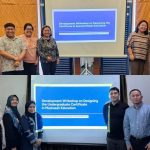
Dr. Pegg TEC is joined by colleagues from RITQ, BRHOD, NEAP, and EDCOM II.
The discussion also covered the importance of mentors and mentees in school systems, the significance of Learning Action Cells (LAC) in fostering a culture of collaborative expertise, and the various phases of teacher career life cycles, including preparation, entry into the profession, professional learning, and performance evaluation.
In a collaborative segment, Dr. Pegg and TEC secretariat Executive Director Dr. Jennie Jocson examined how the roles of TEC intersect with those of other institutions and identified key focus areas within their scope, such as pre-service and in-service training, as well as the assessment of Teacher Education Institutions (TEIs).
Director Mario Bermudez of BHROD contributed reflections on school performance and evaluation, reinforcing the session’s focus on enhancing educational quality through systemic collaboration and support.
The professional development session provided a valuable platform for sharing insights and strategies, fostering collaboration among key educational stakeholders, and reinforcing the commitment to advancing teacher quality in the Philippines. (RITQ Communications)
https://www.ritq.ph/?p=5879NewsSOLO,Teacher Education Council